
Saline County Court Records After Arrest
Court records after a Saline County jail arrest are not the same as arrest records. The jail side is the booking event: intake, roster status, bond notes, and custody location. The court side begins when the arrest is routed to the court process and the prosecutor reviews the law-enforcement report. A charge can be filed, declined, amended, reduced, dismissed, or replaced as the case develops. That is why a booking charge on a roster can differ from the charge list in the court record.
The local path is arrest, booking, first appearance, prosecutor review, court filing, and case events. The Saline County Prosecuting Attorney serves the 22nd Judicial District and reviews law-enforcement material after an arrest. District Court handles countywide misdemeanor cases, preliminary felony cases, and certain civil matters. Circuit Court handles felony and other major cases through the listed Saline County divisions. For custody or booking information, use Saline County jail inmate records; for booking-photo issues, use Saline County jail mugshots.
The official Arkansas court portal is shown at Search ARCourts.
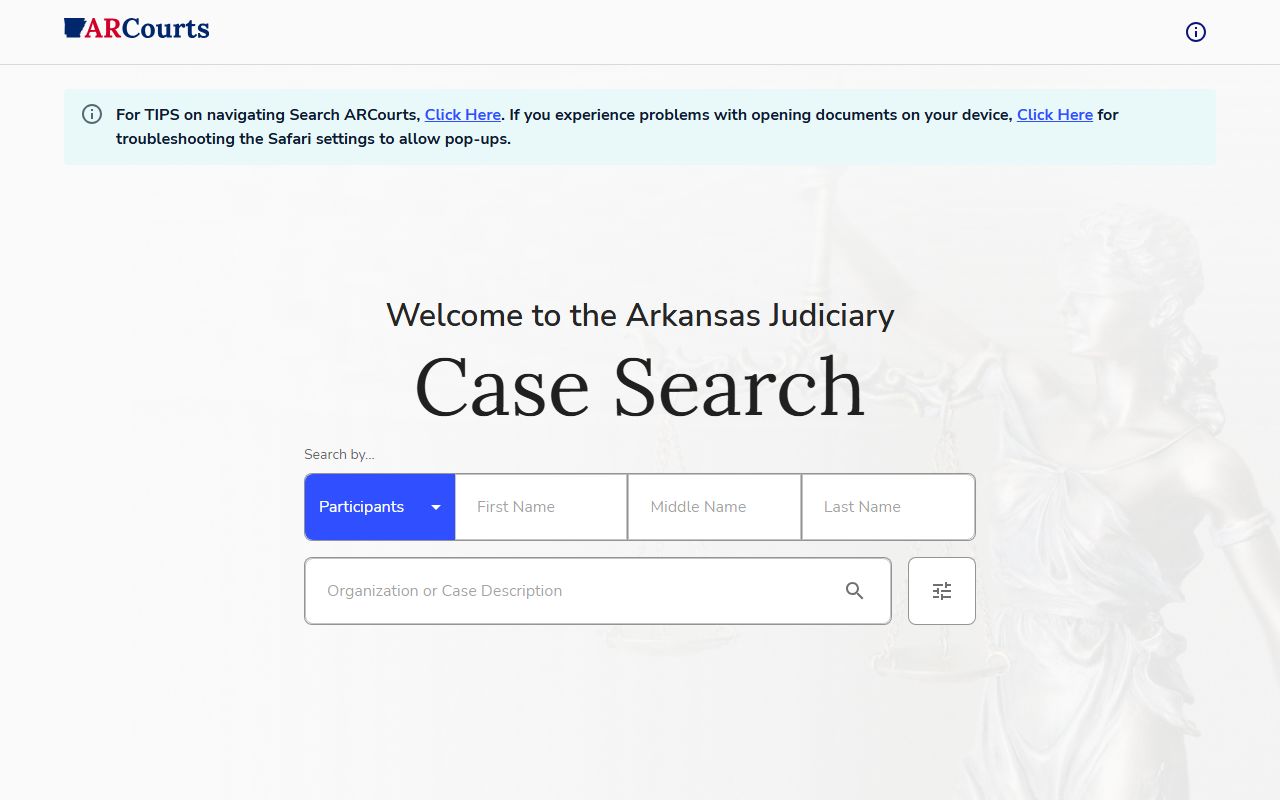
Search ARCourts is the court-record path for filed charges, case events, parties, judgments, and public documents where available.
Search Saline County Court Records
The official Search ARCourts portal provides public case information for courts using Contexte, subject to Arkansas Judiciary access rules and Administrative Order 19 exclusions. For court records after a jail arrest, start with a name and any booking clues available from the county roster, bond paperwork, warrant paperwork, or a booking record. Then narrow by Saline County, court location, case type, date range, date of birth, or case number when those details are known.
- Collect the defendant name, booking date, charge language, warrant court, bond paperwork, or case number if available.
- Open Search ARCourts and choose Participants for a name search or Cases for a case-number search.
- Narrow results with Saline County, court location, date range, date of birth, or case type when the portal offers those filters.
- Open the matching case and compare the formal charge list with the original jail or warrant charge wording.
- Check upcoming events, judge, filings, dispositions, and public documents when the case record provides them.
Older, sealed, certified, or missing records may require contact with the clerk for the court where the case is filed. Arkansas Criminal History, known as ARCH, is a separate statewide criminal-history product. It is not a jail roster and not the court docket, and the research found a $24 nonrefundable search charge for that system.
Saline County Court Search Fields
Search ARCourts supports both participant and case searches. Official Arkansas Judiciary material also describes advanced fields and result controls. The portal fields below are useful when matching court records after an arrest to the correct person and case.
| Field Label | Type | Required | Options or Notes |
|---|---|---|---|
| Search by | Mode selector | Yes | Participants or Cases. |
| First, Middle, Last Name | Text | Optional or search-specific | Participant search; aliases may return in official guidance. |
| Date of Birth | Date | Optional | Useful when associated with the participant. |
| County Name | Dropdown or filter | Optional | Use Saline to narrow a statewide search. |
| Court Location | Dropdown or filter | Optional | Narrows to a specific court location. |
| Case Number | Text | Optional primary field | Use when bond, warrant, or court paperwork lists the case number. |
| Citation Number | Text | Optional primary field | Helpful for citation-based District Court matters. |
| Start and End Date | Date range | Optional | Narrows case search by filing or event range. |
| Rows per page | Dropdown | Optional | Official ACAP material notes 25, 50, or 100 row display options. |
Charging Documents After Arrest
After a Saline County jail arrest, the formal court record depends on a charging document. The specific path can vary by charge level and court process. A complaint, information, or indictment is the document that puts allegations into the court case. It should be read with the docket, hearing history, bond orders, and any later amendments because charge language can change after the first filing.
| Document | Usually Filed By | Common Use | Why It Matters |
|---|---|---|---|
| Complaint | Officer or prosecutor | Misdemeanors and initial allegations | May start the case or support the first court action after arrest. |
| Information | Prosecutor | Many felony cases | Shows prosecutor-filed charges after review of the arrest and reports. |
| Indictment | Grand jury | Serious or grand-jury cases | Shows formal charges returned through grand-jury action. |
The Saline County Prosecuting Attorney page identifies Chris Walton as prosecuting attorney for the 22nd Judicial District. It also directs people to report crimes to the law-enforcement agency with jurisdiction over where the crime occurred. That is distinct from looking up an already filed court case.
Saline County Charge Status
A court charge status is a case-stage label, not a full result by itself. Pending means the allegation remains active. Amended means the prosecutor or court changed charge language. Dismissed means the charge was ended by court action, but related records may still exist unless sealed. Nolle prosequi means the prosecutor declined to proceed on that charge at that time. Disposition means the outcome, such as guilty plea, trial verdict, dismissal, or sentencing.
| Status | What It Means | Record Caution |
|---|---|---|
| Pending | The charge is active and unresolved. | Do not treat it as a conviction. |
| Amended or reduced | The charge changed after filing. | Compare the current charge to the original booking language. |
| Dismissed | The charge was ended by court action. | The public record may remain unless sealed or otherwise restricted. |
| Nolle prosequi | The prosecutor declined to continue that charge. | Check the docket for related counts or later filings. |
| Convicted or guilty | A plea or verdict resulted in guilt on a charge. | Use the disposition and sentencing entries for the final result. |
Saline County Courts and Prosecutor
Saline County criminal cases can involve District Court, Circuit Court, and the Prosecuting Attorney's Office. District Court has countywide misdemeanor jurisdiction and handles preliminary felony matters. Circuit Court divisions are listed by the county with judges, rooms, and phone numbers in Benton. The prosecutor's office reviews law-enforcement reports and decides whether to file, amend, reduce, or dismiss formal charges after a jail arrest.
The county's Circuit Court page lists the divisions and court contacts, while the District Court page explains misdemeanor and preliminary felony jurisdiction. The Prosecuting Attorney page gives the office address, phone, hours, and staff roles.
The prosecutor source is useful for understanding who reviews the arrest file before formal court charges appear.
Bond and Warrant Records
Bond can appear in jail records, warrant information, and court records after a Saline County arrest. The sheriff's fines and fees page says bonds, fines, fees, and restitution may be paid at the Sheriff's Office from 8:00 a.m. to 4:00 p.m. Monday-Friday by cash, money order, or cashier check in the exact amount payable to SCSO. Personal checks, credit cards, and debit cards are not accepted for that local payment channel.
| Bond Type | How It Works | Local Note |
|---|---|---|
| Cash bond | Money is deposited with the proper official. | SCSO accepts cash during posted weekday hours for bonds. |
| Surety bond | A licensed professional bail bonding company posts the bond. | SCSO accepts surety bonds on warrants with a bond amount. |
| O/R or PR bond | Release on promise to appear. | SCSO says it generally will not accept or approve O/R bond for arrest warrants. |
| No-bond warrant | No payment releases the person until judicial action. | The person stays in custody until appearing before a judge. |
For warrants, the sheriff's page says anyone can obtain arrest-warrant information by calling (501) 303-5609. Information may include warrant date, charges, bond amount, and issuing court. No public online active-warrant search form was found in the official material.
Charges Versus Convictions
A Saline County court record after a jail arrest can show charges long before it shows a conviction. A charge is an allegation. A conviction is a final result through a plea, verdict, or other court outcome that establishes guilt on a count. This distinction matters because jail rosters, warrants, and early court records can all list accusations that later change or end.
| Point | Charge | Conviction |
|---|---|---|
| Stage | Accusation after arrest, warrant, or prosecutor filing. | Final guilt result by plea, verdict, or qualifying disposition. |
| Proof level | Based on probable cause or filed allegations. | Requires a legal finding or plea under court rules. |
| Can change? | Yes, it may be amended, reduced, dismissed, or replaced. | May be appealed, modified, or sealed only through legal process. |
| Where to verify | Search ARCourts, docket filings, and court clerk. | Disposition and sentencing entries in the court record. |
Sealed and Expunged Records
Arkansas public access rules contain important limits. Ark. Code § 25-19-105 gives Arkansas citizens public-record inspection and copying rights unless an exemption applies. SCSO records guidance lists open investigations, juvenile records, certain personnel records, sealed or expunged records, and protected information as access limits. For criminal case cleanup, Arkansas sealing law appears in Ark. Code § 16-90-1401 et seq. and related ACIC sealing resources.
| Point | Sealed | Expunged |
|---|---|---|
| Public visibility | Hidden or restricted from ordinary public access. | Often treated as removed from public view under the governing order. |
| Official access | Some agencies may still have lawful access. | Access depends on statute, order, and agency role. |
| How it happens | Through court process and eligibility rules. | Through Arkansas sealing or expungement procedure when eligible. |
| Effect on jail records | SCSO identifies sealed and expunged records as exceptions to normal access. | County release depends on the actual court order and record type. |
Important: Public case lookup is not a consumer report and should not be used for employment, housing, credit, insurance, or other FCRA-covered decisions.